Many old Istrian houses have a cistern (gustirna or šterna, Italian cisterna) that once stored roof water for the household. Today there are three sensible options: restore it for watering the garden and flushing toilets, close it safely, or turn a dry one into a technical room. Drinking the water again is not advisable without treatment and regular testing.
Below is what these cisterns are, what owners usually find when they lift the lid, how each option works, and the water realities in Istria that make a working cistern worth having.
What is a gustirna, and how did it work?
Istria is limestone country, and rain disappears quickly into the rock. Before public water supply, people stored it. Construction of the Istrian regional water system began in 1930, when the Sveti Ivan spring near Buzet was captured, and the network then spread over the following decades. Until it reached them, towns and villages relied on public cisterns, and most houses had their own.
You can still see the public ones. The cistern on the square in Vižinada was built in 1782 to a design by the architect Simone Battistella; water from the surrounding roofs was filtered and stored inside, and according to the local tourist board it holds around 600,000 litres. Each family could draw a set daily amount until mains water arrived. Svetvinčenat's square has a stone cistern from 1808. The carved stone well-head on top is called a puteal, in Italian vera da pozzo.
A house cistern works the same way on a smaller scale: gutters and downpipes lead roof water into a vaulted underground tank under the courtyard or the house, lined with waterproof render, with a stone well-head and a lid on top. Water was drawn with a bucket and chain, later with a hand pump.
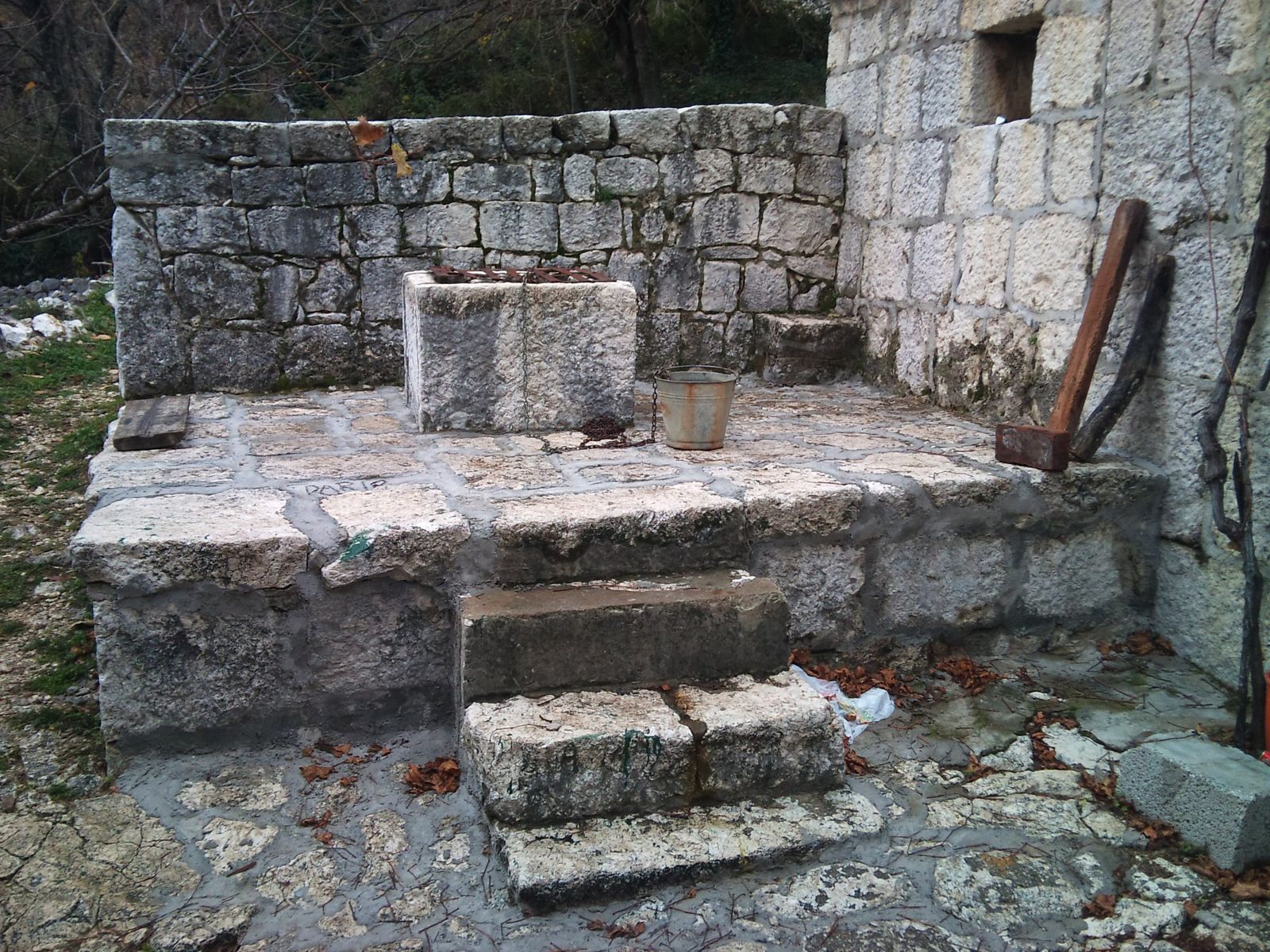
What do owners usually find?
- Cracks and leaks. The water level drops between rains, or the cistern never fills.
- Silt and debris. Leaves, soil, sometimes dead animals at the bottom, and a bad smell.
- Mosquitoes. An open overflow or a gap under the lid turns the cistern into a breeding ground, now often for the tiger mosquito.
- Missing or rotten lid. Boards or a loose stone instead of a proper, heavy cover.
- Disconnected downpipes. Later roof repairs often sent the water elsewhere.
- Surprises. A cistern under a later extension, under the driveway, or one nobody knew about until a digger found the void.
To judge the condition, pump it empty and inspect it from above with a strong light: the vault, the lining, the floor and the inlets. Measure it to know the volume (length × width × depth in metres = cubic metres; one cubic metre is 1,000 litres). After the next good rain, watch whether the level holds.
Is it safe to go into an old cistern?
Not without precautions. A cistern is a confined space: rotting organic matter can use up the oxygen and give off gases such as carbon dioxide and hydrogen sulphide, and people who climb in to help someone who has collapsed often become the next victims. The rules are simple:
- Never go in alone, and never without forced ventilation and someone outside who can raise the alarm.
- Never run a petrol pump or generator inside or next to the opening.
- Treat the vault with suspicion: do not drive or park over an old cistern until it has been checked.
- Keep a heavy, secure lid on it at all times, especially with children, guests or pets around.
Restore, close or reuse: which option fits?
| Option | Good for | Watch out for |
|---|---|---|
| Restore for rainwater | Garden watering, toilet flushing, topping up a pool | Waterproofing, filters, a pump, separate pipes; not drinking water |
| Close safely | Cisterns you will never use, or ones under driveways and extensions | Proper filling or capping; keep the well-head; record where it is |
| Technical room | A dry cistern near a pool or garden | Damp, ventilation, safe access, electrics in a wet space |
Restoring a cistern for the garden and toilets
- Empty and clean out the silt, then repair cracks. If the vault is cracked or deformed, a structural engineer should look at it first.
- Waterproof. Traditional cisterns were lined with lime-based render. Today the usual choices are a new lime or cement-based waterproof render, a flexible waterproofing coating, or a liner or plastic tank placed inside the old shell. The right one depends on the state of the walls and what the water is for.
- Clean water in. Leaf guards on the gutters, a first-flush diverter that sends the dirtiest first rain away, and a filter before the inlet.
- Mosquito-proof. A tight lid and fine mesh on the overflow and any vents.
- Pump and pipes. A pump with a floating suction filter, and a separate pipe system marked as not drinking water. It must never be connected directly to the mains; if mains water tops up the tank, that needs proper backflow protection.
- Electrics. Power for the pump in a damp location should be installed by a qualified electrician.
We coordinate this kind of job through our plumbing service, with the right tradesmen from our network. For the rest of the pipework in an old house, see our guide to plumbing problems in old Istrian houses.
Closing a cistern or turning it into a technical room
To close one safely, it is usually filled with clean inert material or capped with a slab designed for the load above it. Keep the carved well-head: even on a closed cistern it is a beautiful garden piece, and in protected old-town zones removing it may need approval anyway. A dry, sound cistern can also become a plant room for a pool pump and filter, or a store, if it gets reliable waterproofing, ventilation and safe access. Our guide to building a swimming pool in Istria covers the pool side, and renovating an Istrian stone house the wider picture.
Can you drink water from a cistern?
Not as it comes. Roof water carries bird droppings, leaves, dust and whatever has fallen into the tank, so it can contain bacteria even when it looks clear. Making it drinkable takes proper filtration and disinfection, plus regular testing by an accredited laboratory. For a house on the mains, it is simpler to keep the cistern for the garden and drink tap water.
Water in Istria: utilities, summer restrictions and tankers
Public water supply in Istria is run mainly by two utilities: Istarski vodovod (now Istarski vodovod i odvodnja) in Buzet, which covers the north, west and centre, including Umag, Novigrad, Poreč, Rovinj, Buzet and Pazin; and Vodovod Pula–Labin, formed when Vodovod Labin was merged into Vodovod Pula in 2025, which serves Pula, Labin and much of the south and east. Check your water bill to see which one is yours.
Dry summers put the network under pressure. Under Istria County's framework decision on water restrictions, adopted in 2012, the first stage bans uses such as washing courtyards and cars with mains water, and the second stage also bans filling and washing swimming pools. In July 2022 the county introduced restrictions that banned watering public and private green areas, later lifted when conditions improved. In August 2026 the Buzet utility warned villages including Vižinada, Višnjan and Tinjan to cut garden watering or face restrictions, explaining that the limit was pipe capacity at peak times rather than water at the source. Rules change, so check your utility's current notices.
That is why many owners fill pools from a water tanker (autocisterna) rather than the tap, and why some isolated houses away from the mains still rely on a cistern topped up by tanker. A working cistern is a useful buffer: every millimetre of rain on 100 m² of roof gives about 100 litres, and most rain falls between autumn and spring, exactly when the garden needs it least. Stored, it can carry a garden through the first dry weeks of summer, and our garden and outdoor care team can check the system while you are away.
Found an old cistern, or not sure what is under that stone lid? Send us photos on WhatsApp and we will suggest whether to restore, reuse or close it, with a rough price range.
Frequently asked questions
Can I drink the water from my cistern in Istria?
Not without treatment. Roof water can contain bacteria from bird droppings, leaves and debris. Drinking it safely needs filtration, disinfection and regular testing by an accredited laboratory. Most owners on the mains use the cistern only for the garden and toilets.
Can I fill my pool from the mains in Istria in summer?
Usually yes, unless restrictions are in force. Under the county framework, a second-stage restriction bans filling pools with mains water. Many owners use a water tanker anyway to avoid straining the local network. Check your utility's current notices before filling.
How do I keep mosquitoes out of a cistern?
Fit a tight, heavy lid and fine mesh on the overflow and every vent, keep gutters clean, and do not leave buckets or containers of water standing around. The tiger mosquito, common on the Croatian coast, breeds in very small amounts of still water.
How much rainwater can a cistern collect?
Roughly one litre per millimetre of rain for each square metre of roof. A 100 m² roof gives about 100 litres per millimetre, so even a modest Istrian winter can fill a cistern of several cubic metres, if the gutters and inlet work.
Should I fill in an old cistern?
Only if you will never use it or it sits under a driveway or extension. Have it checked first; a sound cistern is valuable for the garden. If you do close it, use clean inert fill or a designed slab, and keep the well-head.